
Ssokpin
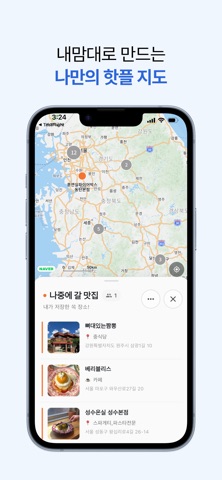
Save restaurants and places discovered on social media to a personal map and collections.
- Platform
- iOS · Android · Web
- Role
- Product · Development
- Period
- 2025.11 — 2026.03
Status
Live
Place extraction
~4 s
Scope
- Planning
- Design
- Development
- Operations
App screens
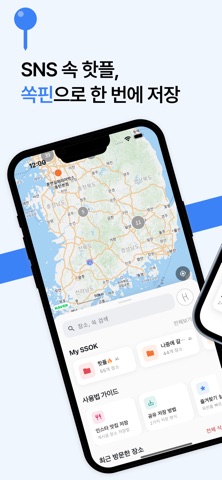
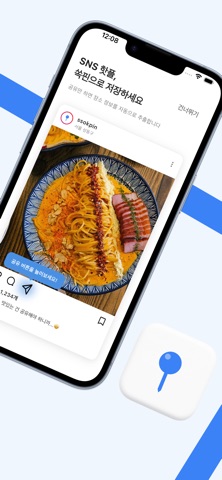
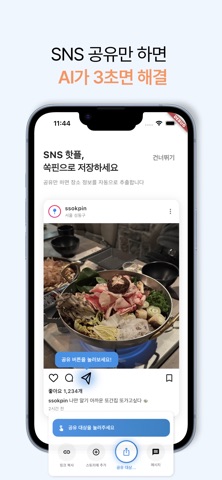
Why I started
I saved restaurants and cafés on Instagram, but choosing a meeting spot or planning a trip meant finding the post again, copying its address, and searching on a map. Saved posts kept growing without becoming a usable list.
Ssokpin began to reduce that effort: share once to keep a place on a personal map, then find it again by location and collection.
Start from the sharing flow
The user has already discovered the place on Instagram, so I centered the product on the share extension. Choosing Ssokpin sends the link directly into place review and saving.
This carries the discovery context into saving before the user postpones it.
Set boundaries for web data
Building this flow led me to study web data and crawling. Technical feasibility alone does not establish whether data belongs in a product.
Ssokpin checks necessary public metadata only when a user explicitly requests a shared URL. It uses Open Graph metadata provided for external sharing to form candidates rather than copying full articles or storing platform content.
This does not imply automatic permission on every site. Service policies, robots guidance, copyright, privacy, and request limits still require attention. The product does not use unauthorized crawling of Naver pages.
Structure place clues with Gemini
Post text contains place names, menus, and regional clues, but those clues are not yet structured map data.
I initially considered OpenAI models. In December 2025, I compared gpt-5-mini and gemini-2.5-flash-lite over one hundred calls each with the same input and output format. Average latency was around ten seconds versus under four seconds, leading me to choose Gemini for extraction.
Related writing · Why I chose Gemini for Ssokpin: the wait came first
Gemini structures names, regions, and menus from the shared URL’s text and metadata. It turns incomplete language into candidate information for place search, which is then compared with Google Places. Ambiguous candidates can be selected or edited by the user.
Adapt saving to the number of places
A few places are easier to review through individual photo and address cards, choosing a different collection for each. Many places make that repetitive, so the default threshold of five separates cards from a list. Users can fix a preferred mode or adjust the threshold.
The list applies a default collection, then allows exceptions or exclusions. Saving groups places by collection and opens the saved pins on the map afterward.
Related writing · Why Ssokpin saves a few places differently from many
Run only when needed with Lambda
Shared-link processing does not require a continuously running server. I used Lambda so requests trigger processing, metadata retrieval, and candidate extraction only when needed, avoiding large fixed infrastructure costs in the early stage.
Connect clues to actual map information
Google Places provides structured names, addresses, and coordinates to turn candidates into real pins. Naver Maps integration lets Korean users continue to directions in a familiar map service. That integration supports navigation rather than data collection.
Keep the map usable as saves grow
Nearby pins are clustered so a wider view shows density and zooming reveals individual places. Collection colors and filters help answer whether the user has saved somewhere nearby.
Decisions I kept
AI extraction improves search rather than finalizing data
Branch names, nicknames, menus, and regions are mixed together. Treating Gemini’s output as candidates protects the core data flow when extraction is imperfect or the model and prompt change.
External dependencies bring operating costs and risks
The flow combines AI APIs, place APIs, and external pages. Per-request cost, failure rates, policy changes, and latency all matter. Lambda suited initial traffic better than an always-on server. I learned to ask what a feature costs even without traffic.
Map UX is about exploration density
Pins work well when there are few. As saves accumulate, clustering, colors, and filters control information density around what the user is trying to find.
A shipped product needs measurement and revision
Link retrieval failure, candidate mismatches, and abandonment before saving have different causes. Alongside new screens, I want to design which signals will support the next product decision.